
Suspended turn-taking during Noem’s (other) congressional hearing
Here’s how conversation works, approximately: one person speaks and when they are done the other responds, and so on, back and forth. If you’re talking to someone, one reason to wait your turn is so that you can attend to what they are saying to you, in order to respond. It’s hard to do that while you talking at the same time. Conversation would look much different in both parties spoke at once and then, at some cue, each responded to what the other one just said in overlap.
And yet, sometimes turn-taking breaks down and people talk, or shout, over each other. The impact of this on each speaker’s utterance can be seen in various kinds of “perturbations,” such as word repeats, stretched phonemes, and grammatical lapses. It’s also possible for the “survivor” of a period of overlap to respond to what the other person just said. This demonstrates that people can simultaneously produce speech and process it (Schegloff 2000), though the two cognitive processes interfere with one another (Barthel 2026), making it hard.
Usually, when overlap occurs, one person backs down pretty quickly, especially if the other raises his or her voice, as a way of demonstrating an elevated determination to prevail (Schegloff 2000). Thus, it is especially interesting when this device fails and overlapping talk is sustained. For ease of reference, I’ll refer to this as overtalk.
We have an example of that from a few weeks ago, compliments of Kristi Noem, who at the time had not yet lost her job as head of Homeland Security. (I wrote about how that happened.) On March 4, she testified before the House Judiciary Committee. In a widely re-played exchange, Congresswoman Kamlager-Dove (D-CA) asked her a question about her relationship with political operative Corey Lewandowski and Noem refused to answer though she did respond. This resulted in a period of overtalk.
Here’s the audio:
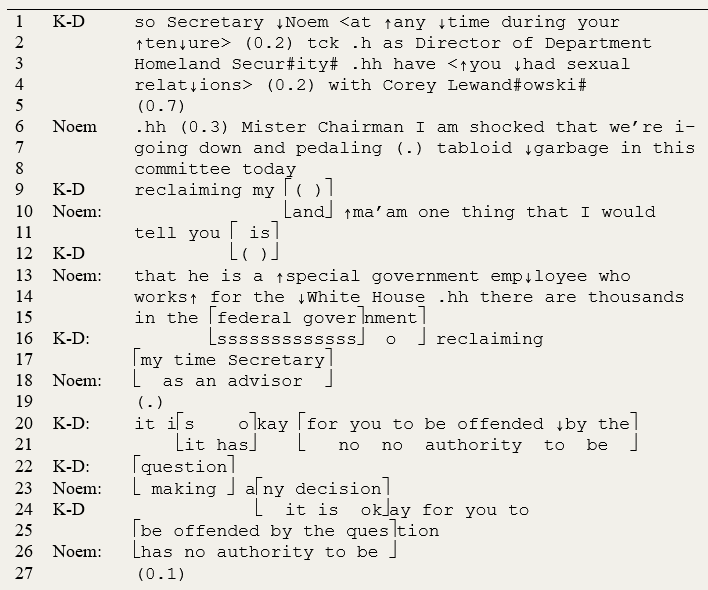
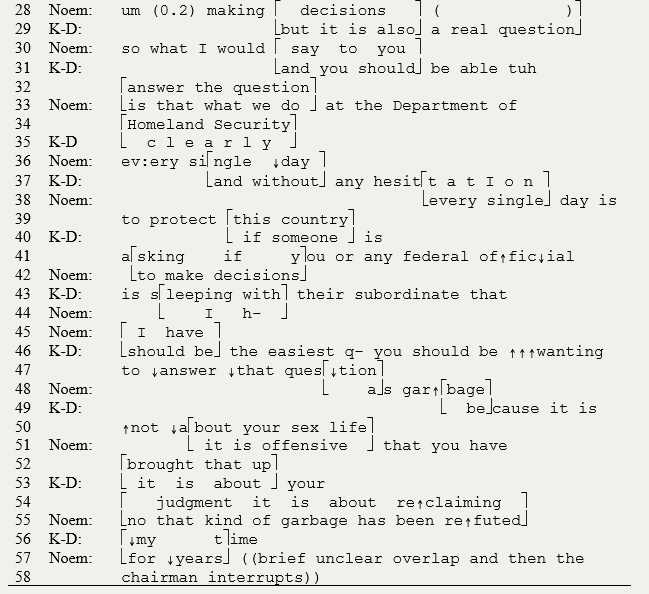
I transcribed this using the conventions of conversation analysis, but it’s ugly and hard to read. It’s at the bottom of this post. Transcribing conventionally, here’s how it all began, starting at 5:15:29 of the video above.
Kamlager-Dove: “So Secretary Noem, at any time during your tenure as Director of Department Homeland Security have you had sexual relations with Corey Lewandowski?”
Noem: ”Mister Chairman, I am shocked that we’re going down and pedaling tabloid garbage in this committee today.”
K-D: “Reclaiming my-“
Noem: “And ma’am, one thing I would tell you is that he is a special government employee who works for the White House. There are thousands of them in the federal government.”
This was an odd way to begin, as the number of Lewandowski-like federal employees was hardly pertinent to the question of whether she’d had sex with the one so named. Nonetheless, this is where the overlap began. Let’s first consider what each said during this period.
Noem: “And as an advisor, it has no, no, authority to be making any decision, it has no authority to be, um, making decisions. (unclear) So what I would say to you is that what we do at the Department of Homeland Security every single day, every single day is to protect this country, to make decisions. I h- I have.”
which overlapped with
Kamlager-Dove: “Sssso, reclaiming my time, Secretary it is okay for you to be offended by the question. It is okay for you to be to be offended by the question. But it is also a real question and you should be able to answer the question clearly and without hesitation, if someone is asking if you or any federal official is sleeping with their subordinate. That should be…“
We see perturbations in each case. Noem probably meant to say that “he” has no authority, and then repeated both the “no authority” line and “every single day.” And then at the end she restarted “I have.” Kamlager-Dove, in the meantime, repeated the “it is okay line” but seemed less flustered overall.
The overlap ended because Noem stopped talking. Finding herself speaking in the clear, Kamlager-Dove self-interrupted and restarted her sentence, with a heightened insistence that Noem provide a proper answer:
K-D: “…the easiest q- you should be wanting to answer that question.”
Noem: “As garbage?”
K-D: “Because it is not…”
And then overlap resumed, with
K-D: “…about your sex life. It is about your judgment, it is about reclaiming my time.”
which overlapped with
Noem: “It is offensive that you have brought that up. No, that kind of garbage has been refuted for years.”
Conversation Analysis co-founder Emanuel Schegloff (2002: 293) one wrote that “overlaps can be extended to considerable length if neither party drops out…and these invite treatment (both by cointeractants and by investigators) as involving some sort of greater interactional moment or investment for the parties.”
So what explains this instance of overtalk? It takes at least two to overtalk, and the answer needn’t be the same for everyone. Noem, I think, wanted to provide a non-answer, and to brag about the work of DHS, and by talking over the congresswoman conveyed her contempt both for the question and the questioner. For her part, Kamlager-Dove wanted to complain about the evasive answer, and the best time to do so was while it was in progress. Both did things through their overlapping that would have been less effective had they respected the docorum expected in this setting, and indeed, in conversation generally.
The CA transcription is below. Conventions are described here.

 Sermo Interruptus
Leave a comment