
Kristi’s Noem’s Self-destruction
On March 5, 2026, President Donald Trump ousted Kristi Noem from her position as Secretary of Homeland Security, allegedly outraged by her testimony in a congressional hearing two days earlier. Specifically, she implicated him in a hugely expensive ad campaign that was simultaneously self-promoting—in one ad, Noem was featured glamorously riding horseback past Mount Rushmore—and corrupt—some of Noem’s associates benefitted financially from the contract. Noem, everyone seems to agree, had become toxic, or more toxic (given her responsibility for ICE outrages), and her removal seemed in the cards—though more than one Trump official has eluded that fate.
What interests me is the moment that Noem credited Trump with approving of the ad campaign, something that she apparently felt she needed to do even as she seemed to try to mitigate his responsibility for this specific advertisement. But Senator John Kennedy (R-LA) was having none of it. This started at 1:14:58 of the above video.
I resist starting with a long excursus on congressional hearings. Basically, government officials appear voluntarily to answer questions about their work, or they can be subpoenaed, and can be charged with perjury for lying but that rarely happens (Meitl 2007). I’ve written about them repeatedly here. Sometimes witnesses refuse to answer a question (though in principle they can held in contempt for that). One example is Pam Bondi’s response to a question about Jeffrey Epstein, which I wrote about recently. Another example was provided by Noem a day later, when she refused to answer a question about whether she’d had sex with dodgy political operative Corey Lewandowski.
In responding to questions from Senator Kennedy, however, Noem didn’t play that game, perhaps because she did not want to take an adversarial stance towards someone who was often (but not always) been a Trump ally. Or perhaps, even in the Trump era, there’s a line between “questions I can blow off” and “questions I have to answer.”
Immediately before Kennedy launched into the line of questioning that got Noem fired, Kennedy had asked her about her practice of reviewing contracts at DHS, giving her the opportunity to brag that she had been able to save taxpayers over $13.2 billion.
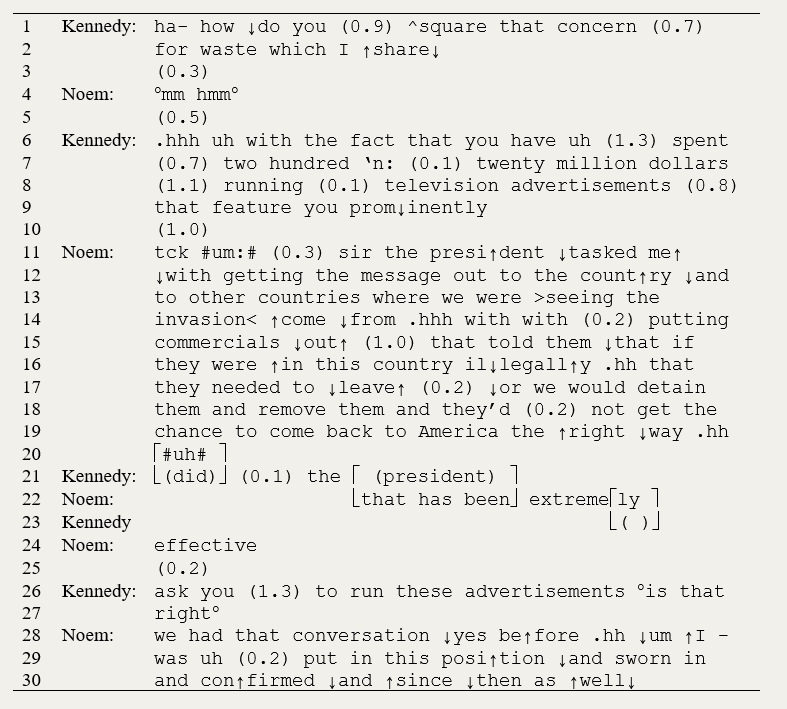
This is where the first excerpt starts; transcribing conventions are detailed here. (I recommend listening to the audio.) In lines 1-9, Kennedy asks Noem to “square” that financial stewardship with the profligate advertisements, something that she must have seen coming. Basically, she is asked to give an account, which Scott and Lyman (1968: 46) define as “a statement made by a social actor to explain unanticipated or untoward behavior,” by attempting to bridge “the gap between action and expectation.” To account for the ads, Noem appeals to a rationale that supersedes frugality, namely instructions from her boss, in pursuit of the goal of reducing the number of illegal immigrants. However, she says that she was “tasked…with putting commercials out,” but not with putting these particular commercials out.
As an account, this falls short of explaining the thing that needs explaining. Kennedy presses her in lines 21 and 26, with a polar (yes/no) : “did the president ask you to run these advertisements?” In line 28, Noem at first appears to answer “yes.” However, she then retroactively dilutes this by saying that “that conversation” was had both before and after she was confirmed. As the advertisements were presumably not conceived until after she was confirmed, this is a way of saying that “that conversation” pertained not to the specifics of the advertisements that were ultimately produced, but to advertisements as a mechanism to spread the message about illegal immigration.
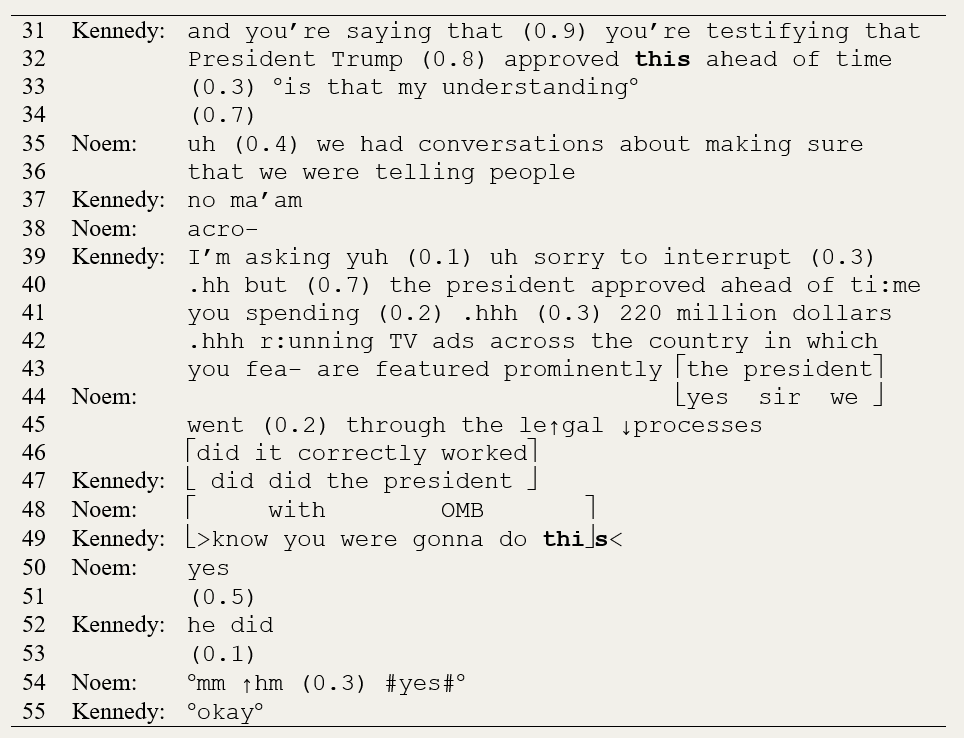
A moment later, after a brief exchange about the contracting process, Kennedy pressed her again. See the second excerpt. In lines 31-33 he offers a paraphrase of her earlier answer, acting as if it was more definite than it was. “You’re…testifying that President Trump approved this ahead of time.” After a hesitation, Noem evades again, and here (in lines 35-36) it is entirely obvious that the “conversations” she’s referring to were on the general topic of messaging, not this ad. Kennedy tries again in lines 39-43, turning the screws even further, asking if the president approved the spending of $220 million on these advertisements specifically. In line 44, Noem again appears to answer straightforwardly, only to obscure this in lines 45 by explaining her compliance with “the legal processes”—so that the “yes sir” in line 44 seems, after the fact, more like an indication that she understood the question than an answer to it. Kennedy tries yet again in lines 47 and 49. Now, however, he relies on the vague “this,” which might explain why, at long last, she answers straightforwardly, in line 50 and then again in line 54.
Noem may have felt that she had avoided throwing Trump under the bus, but he apparently saw things differently. Or maybe, given the well-known facts, it was a futile project from the start: either Noem accepted responsibility for the ad and was fired for it, or blamed the president and was fired for that. Another subtitle I considered for this post: “Noem attempts the impossible and fails.”
Cited
Meitl, P.J. 2007. “The Perjury Paradox: The Amazing Under-Enforcement of the Laws regarding Lying to Congress.” Quinnipiac Law Review 25(3):547-572.
Scott, Marvin B. and Stanford M. Lyman. 1968. “Accounts.” American Sociological Review 33(1):46-61.

 Sermo Interruptus
Leave a comment