
The Perils of Unscripted Speechifying
On February 11, 2026, U.S. Attorney General Pam Bondi testified before the House Judiciary Committee for more than four hours. The full video is above. A main focus was the Epstein files. A little over fifty minutes in, Representative Jerry Nadler (D-NY) asked Bondi how many of Epstein’s co-conspirators her office has indicted.
A New York Times editorial describes what happened next like this: “[A]t one point, in a bizarre non sequitur, she responded to a question she did not like by boasting that the Dow Jones industrial average had surpassed 50,000 points.”
The L.A. Times says something similar: “When Rep. Jerry Nadler (D-NY) asked how many of Epstein’s accomplices she had indicted, rather than tell the truth — which is none — she launched into a non-sequitur talking point about the Dow Jones Industrial Average topping 50,000.”
Both sources give the impression that the exchange looked like this:
Nadler: “How many of Epstein’s co-conspirators have been indicted?”
Bondi: “The Dow is over 50,000.”
What actually happened is that after a period of chaotic overlapping talk, Republican Lance Gooden (R-TX) yielded his time to Bondi to give her a stretch during which she could respond without interruption. Bondi then launched into a monologue, and it was in the course of this that she backed herself in a corner which necessitated the much-ridiculed non sequitur.
Conversation analysis (CA) has much to say about how people respond to one another in fairly rapid back-and-forth exchanges, akin to a ping-pong match, but less to say about monologues. These come in several forms. One is a story, related more or less chronologically (Labov and Waletzky 1967; Mandelbaum 2013). Another is a persuasive speech, with an overall logic that is mapped out in advance, involving a succession of points that build upon one another in support of a conclusion (e.g., Heritage and Greatbatch 1986). A third, for which I can’t think of a great term, is more like a stream of consciousness, assembled extemporaneously sentence-by-sentence. (Donald Trump is famous for these, whenever he strays from his teleprompter.) A competent story allows the audience to imagine how events originally unfolded. A competent speech is one that communicates reasons supporting a conclusion. A competent stream of consciousness, or spoken train of thought, is one in which each component has a hearable logical relationship to the one that preceded it, though it may seem meandering considered as a whole.
Bondi’s monologue falls into this last category, of a spoken stream of consciousness, though she apparently had some talking points that she either felt compelled to use or that she thought offered her a way out of the corner she talked herself into. It wasn’t pretty.
To repurpose a line from Marx, in conversation we choose what to say but not in circumstances entirely of our own making. In an extemporaneous monologue, we have more control over the circumstances but may not always be happy with our choices a moment later. Sometimes it’s simply because we say things we wish we hadn’t. Other times it’s because those things impose inconvenient strictures on what we can say next without confusing our listeners or seeming unhinged.
With the floor hers, Bondi first chastised committee members for their failure to apologize to Trump for attempting to impeach him. Next, she noted that the Epstein scandal dates back to the Obama era. Then she claimed that the Trump administration is “the most transparent president in the nation’s history,” as evidenced by its release of 3,000,000 pages of the Epstein files (which was basically inescapable following the passage of the Epstein Transparency Act).
Then (at 54:12) began the segment roughly transcribed below, with the audio. (Transcribing conventions are here.)
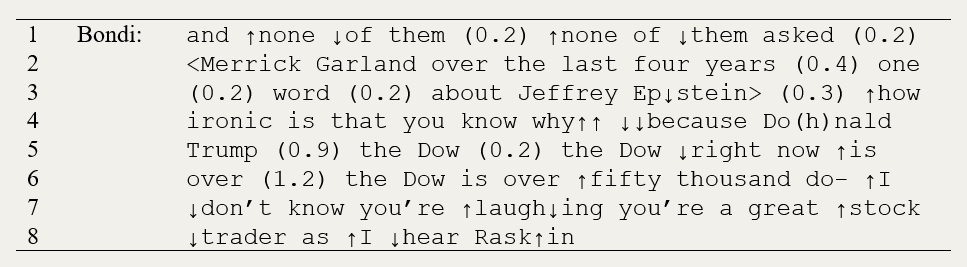
“None of them asked about Merrick Garland over the past four years one word about Jeffrey Epstein,” she begins. “None of them” is repeated (line 1), almost certainly for dramatic effect (cf. Schegloff 1987). Also contributing to this is the repeated emphasis on “none” (indicated by the pitch arrows), the slower tempo in lines 2-3 (indicated by < >), and the pauses (in parentheses). “How ironic is that?” she asks, rhetorically. “You know why?” she continues, posing a question that, in the context of a monologue, anticipates that the speaker is prepared to provide the answer.
This is where she runs into trouble. All of the obvious answers to her question, which now needs answering, involve Trump’s greater entanglement in the Epstein affair, including his 2024 campaign promises to release the files, as demanded by the MAGA faithful. In this sense, it is not surprising that she begins her next sentence—the answer to her question—with Trump as its grammatical subject. Alternatively, not sure how to answer the question, she defaults to talking about the president. Either way, she begins talking about Trump at exactly the moment when she is expected to explain why there was less interest in Epstein under Biden, an expectation she further promises to deliver on with the conjunction “because.” But there may be no good way of finishing the sentence without inculpating her boss.
Let’s pause to consider Bondi’s laugh while saying “Donald,” transcribed as “Do(h)nald.” One reason people laugh while speaking is in order to identify something as discernibly funny, and to invite others to laugh as well (Jefferson 1979), but it’s doubtful that she is inviting the committee to laugh at mention of the president. People also laugh while describing their troubles, such as illness, so as to indicate that they have not been diminished or hobbled by those (Jefferson 1984), but her personal troubles are not overtly at issue here. Glenn (2013) suggests a third possibility, that seemingly nervous laughter is a way of marking that one is engaged in a precarious conversational operation, such as opining about something that the recipient is in a vastly better position to know about.
Bondi’s laughter seems different, however. To me it sounds appreciative, as if she is on the cusp of basking in Trump’s reflected glory—until she remembers that she is still expected to use this sentence to explain the lack of questions to Garland. More generously, she may be saying what I’m about to do is going to sound like groveling but I’m better than that. But the appreciative/reflected glory explanation seems better, as it is too late in the day for Bondi to seek redemption for groveling.
In any event, with no way to finish the sentence, Bondi needs to change the topic, and to unambiguously announce that she has, so that she is no longer heard as providing the promised answer. This, I think, explains her initial repeat of “the Dow” in line 5, which underscores that it is the subject of a new sentence, and not to be heard as a continuation of the aborted one.
In fact, Bondi begins this sentence three times, progressing further each time:
(a) “The Dow”
(b) “The Dow right now is over”
(c) “The Dow right now is over fifty thousand do-“
I think that the first repeat (b) does the work of underscoring that she has abandoned the reference to Trump in favor of changing the topic. The next repeat (c) is something I’ll return to momentarily. Bondi’s self-interruption at the end of (c), or in line 6 in the excerpt, is ostensibly occasioned by apparent laughter by Jamie Raskin (D-MD). However, it may also indicate her uncertainty about the units in which the Dow is measured—which is points, not dollars, which is what she seems about to say. That is, uneasy about her command of the details of that market index, Bondi may have used Raskin’s laughter as an excuse to stop herself from finishing the word “dollar.”
Now let’s return to the second repeat, in (c) and line 6. It’s not obvious from the audio what is achieved by this, but the video reveals something else: a concomitant shift in the direction of Bondi’s gaze. There is no standardized way of representing gaze this in an excerpt, though some options can be found in Goodwin (1980) and Auer (2021). Below I’ve added some gaze annotation to the excerpt (the key is at the bottom), distinguishing between periods when Bondi is looking straight ahead, at the Committee; to the right (which is her left); and down at her notes. What’s interesting is that she first looks down upon mentioning Donald Trump in line 4. Then she briefly looks up and to the right during the pause in line 5, and then back down at her notes when she begins talking about the Dow, looking back up in line 6 as she restarts her sentence. This could indicate a preference (a loaded term in CA but let’s bypass that) for making eye contact with her addressees while speaking, and that this is important enough to incur the cost of the disfluency.
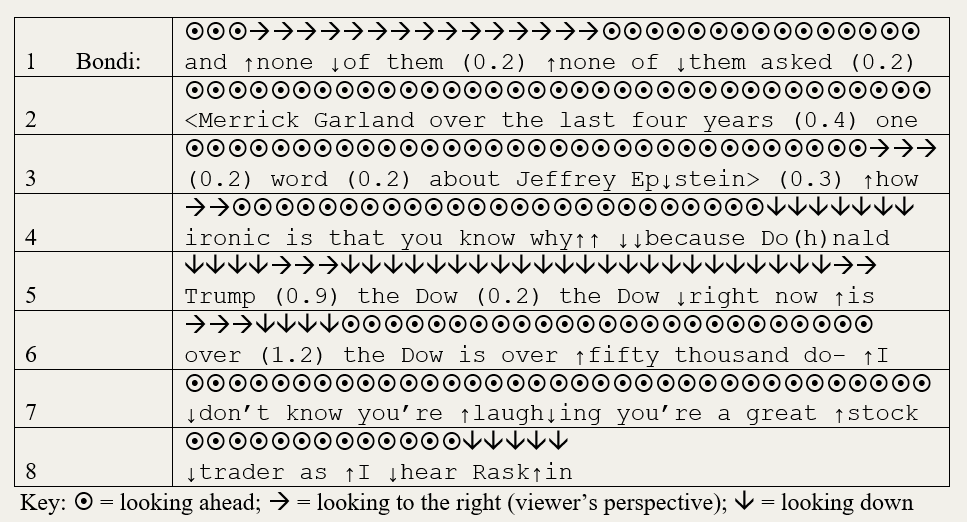
More generally, that she needed to consult her notes in order to reference the president, and then again to reference the Dow, may indicate that they included reminders to turn to these topics in moments of need. (There was a lot of media attention on her notes, which apparently included information about how members of Congress had searched the unredacted Epstein files on dedicated Justice Department computers.)
In any event, Bondi found a way to brag about the stock market, something that she, and presumably President Trump, would very much prefer be the center of attention. But it was comically artless. The assessment from Slate: “This was the most degrading congressional performance for the audience of one in recent memory.” This exchange wasn’t entirely to blame, but it didn’t help.
Cited
Auer, Peter. 2021. “Turn-allocation and gaze: A multimodal revision of the “current-speakerselects-next” rule of the turn-taking system of conversation analysis.” Discourse Studies 23(2):117-140.
Glenn, Phillip. 2013. “Interviewees Volunteered Laughter in Employment Interviews: A Case of “Nervous” Laughter?” Pp. 255-276 in Studies in Laugher in Interaction, edited by Phillip Glenn and Elizabeth Holt. London: Bloomsbury Academic.
Goodwin, Charles. 1980. “Restarts, Pauses, and the Achievement of a State of Mutual Gaze at Turn-Beginning.” Sociological Inquiry 50(3-4):272-302.
Heritage, John and David Greatbatch. 1986. “Generating Applause: A Study of Rhetoric and Response at Party Political Conferences.” American Journal of Sociology 92(1):110-157.
Jefferson, Gail. 1979. “A Technique for Inviting Laughter and its Subsequent Acceptance Declination.” Pp. 79-96 in Everyday Language: Studies in Ethnomethodology, edited by George Psathas. New York: John Wiley & Sons.
—. 1984. “On the Organization of Laughter in Talk about Troubles.” Pp. 346-369 in Structures of Social Action, edited by J. Maxwell Atkinson and John Heritage. Cambridge: Cambridge University Press.
Labov, William and Joshua Waletzky. 1967. “Narrative Analysis: Oral Versions of Personal Experience.” Pp. 12-44 in Essays on the Verbal and Visual Arts, edited by June Helm. Seattle: University of Washington Press.
Mandelbaum, Jenny. 2013. “Storytelling in Conversation.” Pp. 492-507 in The Handbook of Conversation Analysis, edited by Jack Sidnell and Tanya Stivers. Malden, MA: Blackwell.
Schegloff, Emanuel A. 1987. “Recycled Turn Beginnings: A Precise Repair Mechanism in Conversation’s Turn-taking Organisation.” Pp. 70-85 in Talk and Social Organisation, edited by Graham Button and John R.E. Lee. Philadelphia: Multilingual Matters.

 Sermo Interruptus
Leave a comment