
On July 24-25, 2025, Ghislaine Maxwell, confidant of Jeffrey Epstein and convicted sex trafficker, was interviewed of DOJ officials about her knowledge of Epstein’s behavior and that of the famous people he associated with. A few weeks later, the transcript and audio recording were released to the public, apparently because Maxwell repeatedly absolves President Donald Trump of any unseemly, much less criminal, behavior.
Maxwell, whom prosecutors consider a serial liar, was promised that she would not be prosecuted for anything she said so long as she told the truth.
It was at 1:46:26 in the recording from July 24 that Maxwell offered the first of what seemed pre-planned, and fawning, statements about her relationship with Trump. Whether or not this is the truth is beyond me to judge—that this seems scripted doesn’t answer the question either way, though it does suggest that Maxwell knew the moment to say this would arise and, hoping for a pardon or at least reduced sentence, seized it when it did. (As the president was mentioned a few times earlier, she may have been relieved to find that she hadn’t missed her chance.)
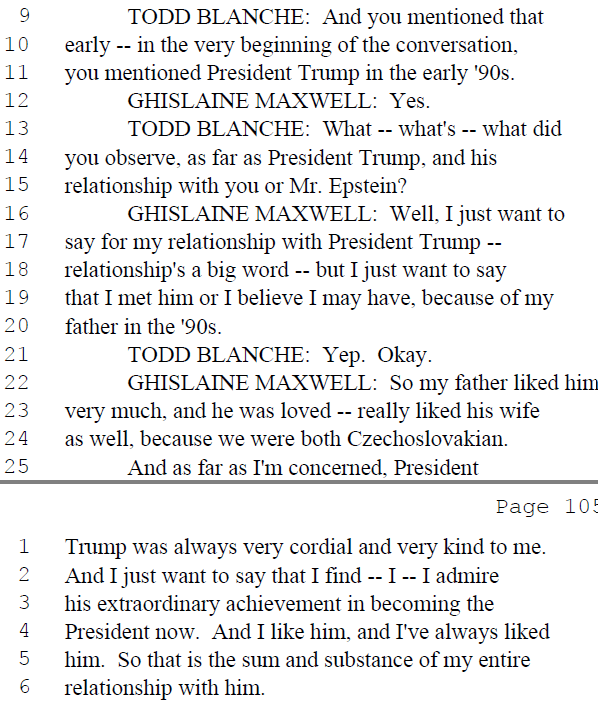
Here’s the official transcript of the exchange in question:
And here’s mine, quick-and-dirty, with the audio clip:
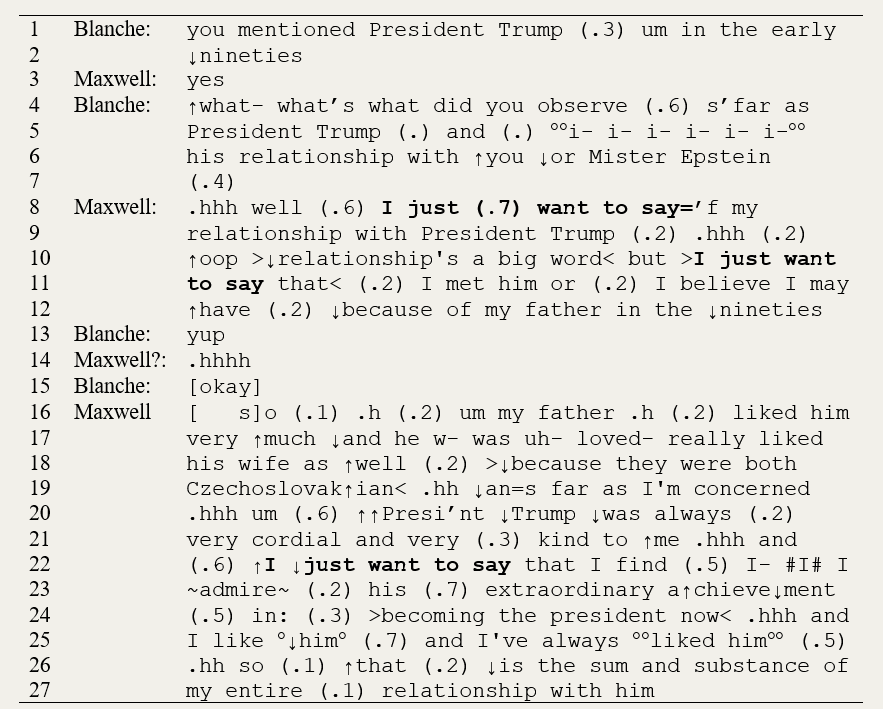
Transcribing conventions are explained here.
Questioning Maxwell is Todd Blanche, deputy attorney general and Trump’s former trial lawyer. In lines 4-6 (of my transcription), he merely asks Maxwell about her, and Epstein’s, “relationship” with the president. (Later he asked her about whether she witnessed Trump doing “anything inappropriate”—her answer was a firm “no.”) The slight stuttering in line 5 could indicate some discomfort in raising the matter.
Maxwell begins her response with the word “well,” which is widely recognized as a harbinger of a response that does not quite fit the question (Heritage 2015). Here, however, it prefaces a story of the origins of her relationship with the president, which in fact is fairly pertinent as an answer to Blanche’s open-ended question. “Well I just want to say,” then, might amount to an announcement that she is going to use Blanche’s question as cover for doing something more than merely answering it, namely to produce her pre-planned statement, which does, in short order, exceed what is required to answer the question.
After resisting the term “relationship,” which repeatedly made her uneasy during the interview, and then repeating “I just want to say,” Maxwell explains that she met Trump through her father, who “liked him very much.” (In the midst of this, Blanche says “yup, okay,” which sounds supportive but may also indicate that the story is already known to him.) Then she says, of Trump, that he was always “very cordial and very kind” to her (line 21).
In line 22, she repeats “I just want to say.” This seems redundant, for hasn’t she been saying what she wants to say since line 8? I think it might mean that the two first iterations of this expression were premature, and that what she really “wants to say,” for the record and most especially for the president, is that she is impressed by the president and has always liked him.
Maxwell’s performance of obsequiousness goes beyond her mere words. Her voice quivers slightly on “admire” in line 23, as if she is genuinely moved or wants to communicate that—something I touched on in an earlier post. Around that time she also starts sounding breathy, exhaling more than necessary to move her vocal cords, and in line 25, her voice has been reduced to a mere whisper.
“That is the sum and substance of my entire relationship with him,” she concludes, presumably also marking the end of what “I just want to say,” and the resumption of her responsiveness to Blanche’s questions.
February 26, 2026 update: The author of the Linguistically Yours Substack offers this more patient analysis of Maxwell’s “sum and substance” remark at the end of the excerpt:
“Sum and substance” is not neutral phrasing. It is register indexicality. It pulls legal-bureaucratic diction into her mouth in a way that:
– indexes competence with institutional speech
– aligns her with the interview’s official purpose (“the record”, evidential closure)
– presents the relationship claim as a completed evidential unit
It could be treated as language ideology in action: an implicit claim about what “counts” as a proper statement in this setting (bounded, summarised, legally phrased, record-ready).
Cited
Heritage, John. 2015. “Well-prefaced Turns in English Conversation: A Conversation Analytic Perspective.” Journal of Pragmatics 88: 88-104.
Further reading
Gibson, D. R. 2016. “Ignorance at Risk: Interaction at the Epistemic Boundary of Bernard Madoff’s Ponzi Scheme.” Qualitative Sociology 39(3), 221-246.
Return to Substack (if that’s how you got here). Please consider liking there or below (if you have a WordPress account).

 Sermo Interruptus
Leave a comment