
On Jun 22, 2025, Secretary of State and Acting National Security Adviser Marco Rubio appeared on CBS’s Face the Nation, where he was interviewed by Margaret Brennan, senior foreign affairs correspondent. The video of the full segment is above. The interviews starts at 2:17. Things took an ugly turn about two minutes later, when Brennan, picking up on a phrase used by Rubio a moment before, asked about U.S. intelligence about Iran’s intentions to build a nuclear weapon. This precipitated a period of sustained overlapping talk which seemed like a breakdown of the normal rules of decorum when senior Cabinet members are interviewed on national television, recognizing that there’s a lot of variation.
I want to focus on one aspect of this: the video latency, or delay, and its consequences for the apparent timing of (attempted) interruptions and overlapping talk.
First, a little bit about interruptions, with an example from another historical era. According to the rules of turn-taking, you can begin responding to someone when they’ve reached a point in their speaking turn that they’ve finished some discernibly complete action (Sacks, Schegloff and Jefferson 1974; Schegloff 1996), regardless of whether they considered themselves done. You can make aggressive use of this by interrupting someone even when they clearly had intended to say more, to respond to their turn-so-far, when that gives you enough to work with. This is particularly advantageous when the turn-in-progress appears to be heading in a dangerous direction.
I wrote about such “opportunistic interruptions” two decades ago (Gibson 2005). That was my first foray into Supreme Court oral arguments, but the example I want to use here came from another setting, namely a Pentagon press conference. This was shortly after the start of the Iraq War. In lines 1-4, the journalist begins to ask Secretary of Defense Donald Rumsfeld a question about the U.S. strategy of (as our leaders were fond of saying) “decapitating” the Iraqi regime. Right away, this is set up as a challenging question by the expression “complicate your effort” (line 1). But the journalist does not get to explain what, exactly, complicates that before Rumsfeld interrupts in line 5. (Transcribing conventions are explained here.)
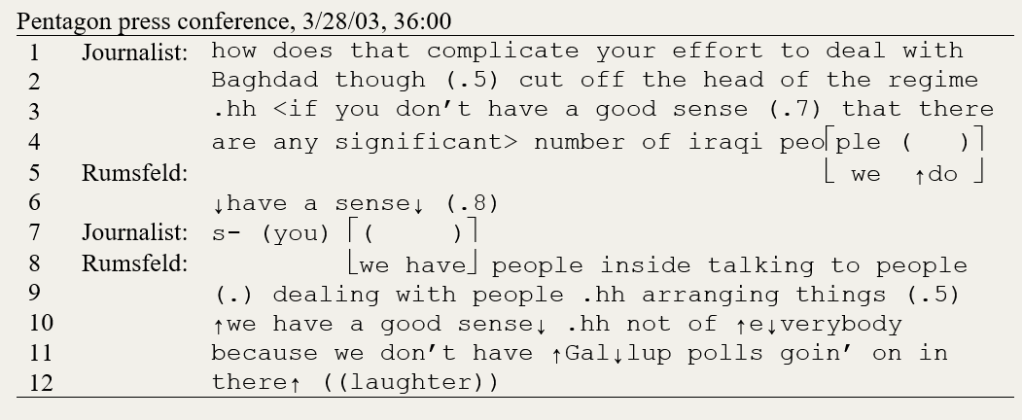
What makes this opportunistic interruption possible is that the journalist gets far enough to suggest that the U.S. lacks information about the Iraqi people, but not far enough to specify what information, exactly, the U.S. lacks. (I suspect it was evidence that the Iraqi populace welcomed the liberators.) This enables Rumsfeld to interrupt to say “we have a sense” and to back that up by vaguely listing U.S. activities in the country.
What’s important for current purposes is the timing of Rumsfeld’s response. It could have come a bit earlier, but any later and he might have had to respond to a more troublesome question or else be heard as evading it. All that was required was a few more words from the journalist: “…who support us.”
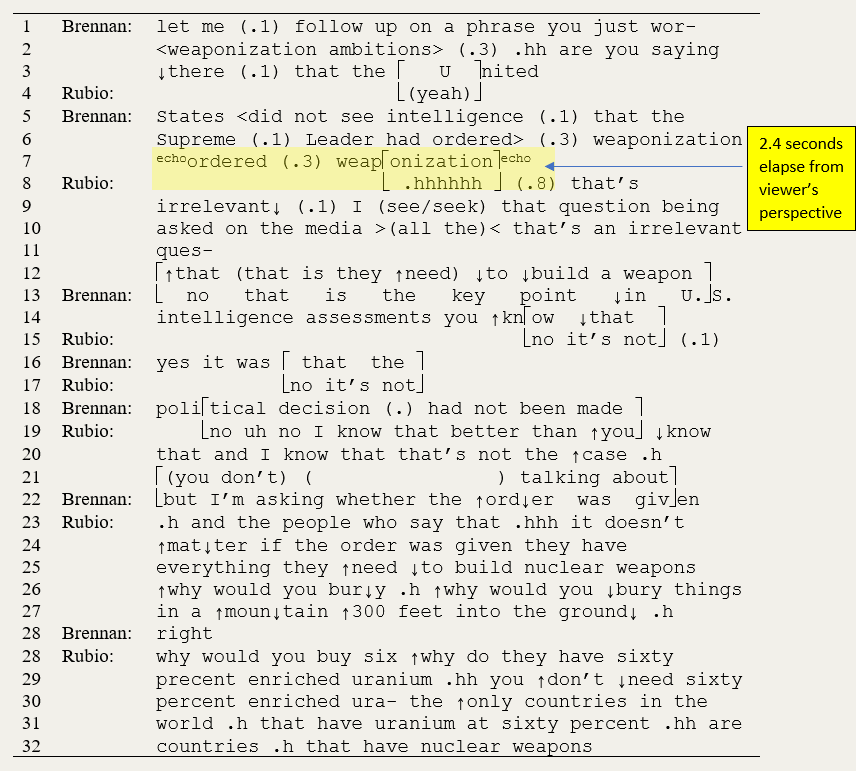
Fast-forward 22 years to a new Middle East conflict. The exchange in question is transcribed below. Rubio’s interview was not part of a press conference, one consequence of which was that he didn’t have his choice of journalists to call so that it was hard to escape the questions put to him by this one. Another is that he wasn’t in the same room, which brings us to the video transmission delay. The first sign of this is the 2 seconds he takes to respond to the first question (not transcribed) about Iranian retaliation. Something similar happens when, in the excerpt, Brennan asks him about U.S. intelligence regarding weaponization: between “weaponization,” the last word of Brennan’s question, and “that’s irrelevant,” the start of Rubio’s reply, a full 2.4 seconds elapse.
Of course, it might be that Rubio simply needs time to think, but on listening to the audio I caught a faint echo of Brennan’s words, which I take to be her words as heard, after a delay, by Rubio, and then transmitted back to the studio, faintly. Listen for yourself:
I transcribed these words in line 7, with superscripts indicating that it’s the echo.
The time it takes for Brennan’s words to bounce back is about 1.7 seconds. (I measured this as the time between her initial start of the word “ordered” and its start in the echo.) That means it took about 850 milliseconds to go in each direction, assuming the travel time was the same each way. This will have the peculiar consequence that the two sides will have different perceptions of what happened simultaneously with what. (There’s a nice analogy to Einsteinian relativity which I will resist expounding upon, but working through that helped prepare me for this.) More specifically, the state of Brennan’s talk at the instant that Rubio begins responding from Rubio’s perspective will not be the state of Brennan’s talk when Rubio begins responding from Brennan’s perspective, and vice versa. That’s evident in the excerpt thanks to the briefly detectable echo if by “state of talk” we mean how much time has seemingly elapsed. Again, from Brennan’s perspective, and the viewer’s, 2.4 seconds elapse between Brennan’s question and Rubio’s reply. But from Rubio’s perspective, only .8 seconds have (the numbers don’t quite add up due to rounding), which is at the upper end of normal for responses to questions in English conversation (Stivers et al. 2009).
This becomes more consequential subsequently. As viewers see all of this from Brennan’s perspective, it is foreseeable that her responses will seem more well-timed than his:
- Rubio’s “yeah” in line 4 is oddly placed. From his perspective, he probably said it right after Brennan’s reference to “weaponized ambitions.”
- Again, Rubio’s response in line 8 is oddly delayed vis-à-vis Brennan’s question, the echo aside.
- Brennan’s attempted interruption in line 12 is precisely timed as an immediate challenge to Rubio’s charge that she had asked an “irrelevant quest[ion].”
- Rubio’s “no it’s not” in line 15 is oddly located, slightly delayed relative to Brennan’s “intelligence assessments,” to which it could be heard to respond, and even more delayed relative to “no, that is the key point,” which is probably what Rubio immediately reacted to from his perspective.
- Rubio’s second “no it’s not” in line 17 actually seems well-timed as an immediate response to Brennan’s “yes it was” in line 16. However, it makes him seem petulant and probably from his perspective this was his response to “intelligence assessments.”
- Rubio’s “no uh no I know that better than you” in line 19 arrives in the midst of Brennan’s reference to a “political decision” but is not responsive to it. If we rewind 1.7 seconds, this was presumably a response to Brennan’s “you know that.”
- Brennan’s interjection in line 22 is well-timed as a response to Rubio’s “that’s not the case.”
I don’t think any of this was consequential for the substantive views Rubio expressed, especially as he had ample time to articulate his talking points during the remainder of the interview (during which Brennan did a lot of supportive backchanneling: “okay,” “right”). But it might have been consequential for the perceived tone of the exchange and Rubio’s experience of it, an experience that might have further agitated him, to the detriment of his self-presentation. Better to have been Rumsfeld in person in 2003 than Rubio joining remotely in 2025.
Cited
Gibson, David R. 2005. “Opportunistic Interruptions: Interactional Vulnerabilities Deriving from Linearization.” Social Psychology Quarterly 68 (4): 316-37.
Sacks, Harvey, Emanuel A. Schegloff, and Gail Jefferson. 1974. “A Simplest Systematics for the Organization of Turn-Taking for Conversation.” Language 50 (4): 696-735.
Schegloff, Emanuel A. 1996. “Turn Organization: One Intersection of Grammar and Interaction.” Pp. 52-133 in Interaction and Grammar, edited by Elinor Ochs, Emanuel A. Schegloff, and Sandra A. Thompson. Cambridge, UK: Cambridge University Press.
Schegloff, Emanuel A., and Harvey Sacks. 1973. “Opening Up Closings.” Semiotica 8 (4): 289-327.
Stivers, Tanya, N.J. Enfield, Penelope Brown, Christina Englert, Makoto Hayashi, Trine Heinemann, Gertie Hoymann, Frederico Rossano, Jan Peter de Ruiter, Kyung-Eun Yoon, and Stephen C. Levinson. 2009. “Universals and Cultural Variation in Turn-taking in Conversation.” Proceedings of the National Academy of Sciences 106 (26): 10587-92.

 Sermo Interruptus
Leave a comment